
Key takeaways
- Director Yeon Sang Ho cast Kim Hyun Joo as his only choice for Ryu So Young from the beginning of development, describing the role as extremely difficult to navigate without veering into artificiality or opacity.
- The character must contend with three versions of her son simultaneously: the child she lost nine years ago, the preserved younger version she accessed through the AI program, and the adult stranger now in her home.
- Kim Hyun Joo's performance remains emotionally unstable rather than resolving toward acceptance, capturing So Young's permanent state of disequilibrium and confusion.
- The film uses technology meant to ease grief to explore how artificial preservation can trap people in the past, complicating genuine reunion with the person who has actually returned.
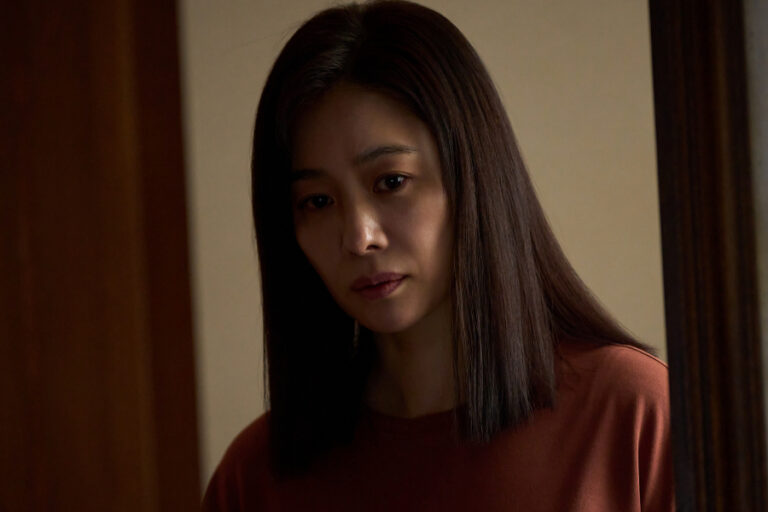
Yeon Sang Ho’s latest thriller, “Paradise Lost,” traces the psychological dissolution of a mother confronted with her son’s return after nine years of absence. Recent stills featuring Kim Hyun Joo reveal a woman fractured by conflicting emotions, caught between relief and dread, reunion and alienation.
The Premise and the AI Program
The setup is deceptively simple yet conceptually baroque. Sun Woo (Bae Hyeon Seong) vanished nine years ago. During his prolonged absence, his mother, Ryu So Young (Kim Hyun Joo), discovered an unconventional coping mechanism: the AI program “Children of Paradise,” which allowed her to interact with a digital version of her son preserved in childhood. These interactions provided a form of continuity, a way to speak with and relate to the child she had lost. When Sun Woo reappears, alive and unexpectedly adult, So Young encounters a fundamental rupture. The man before her bears little resemblance to either the boy she lost or the child she has been mourning through the screen. He is a third entity, biologically her son, but psychologically and developmentally unrecognizable.
Kim Hyun Joo and Yeon Sang Ho’s Ongoing Collaboration
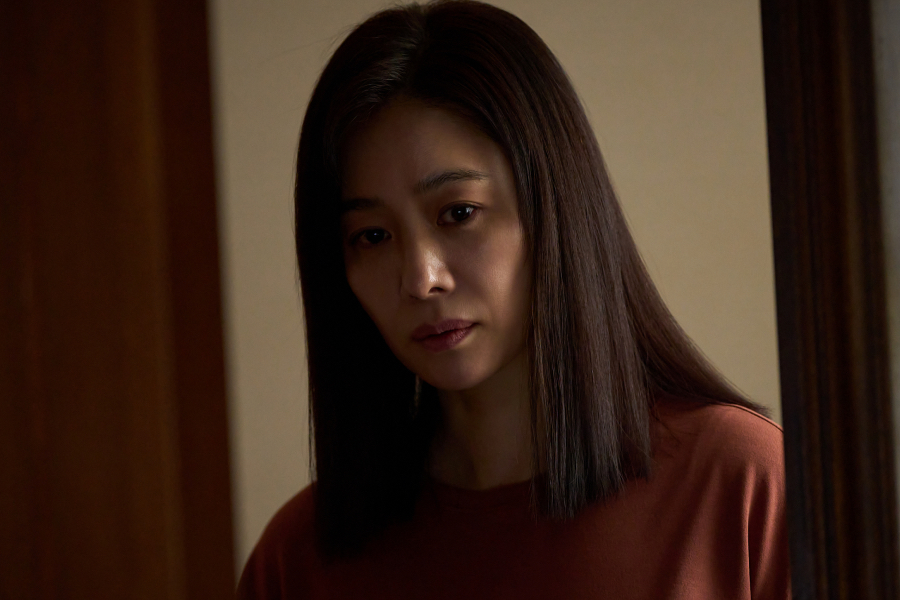
This marks Kim Hyun Joo’s fourth project with Yeon Sang Ho, following “Hellbound,” “Jung_E,” and “The Bequeathed.” The director has made no secret of his reliance on this particular collaborator. He considers her “one of the first actors I think of when developing a new project,” crediting her with an ability to embed authenticity within even the most conceptually ambitious narratives. For “Paradise Lost,” his commitment to Kim Hyun Joo went further: she was the only actress he considered for Ryu So Young from the project’s inception.
A Pattern of Understanding
This pattern of recurring collaboration speaks to a working relationship built on mutual understanding and creative compatibility. Each previous partnership has deepened the director’s confidence in her interpretive capabilities, making her an essential element of his directorial vision before a single script page is written.
The Demands of the Role
Navigating Emotional Extremes
The role itself demanded casting decisions driven by specific artistic requirements rather than general suitability. Yeon Sang Ho characterized the part as “an extremely difficult role in which too strong a performance can feel artificial, while holding back too much can make the emotions difficult for the audience to pick up on.” This description identifies a precise problem: the character cannot be played loudly or performed with conventional dramatic urgency, yet she also cannot be rendered so quietly that her inner turbulence remains opaque. It is a balance that requires not just technical skill but intuitive understanding of emotional subtlety.
The difficulty lies in avoiding two equally damaging pitfalls. Overplay the role, and authenticity evaporates into melodrama. Underplay it, and the character becomes inscrutable to viewers, her suffering visible only to the performer. Yeon Sang Ho explained his casting choice by stating, “I wanted to entrust this role to the most trustworthy actress I have worked with throughout my filmmaking career.” That emphasis on trust suggests the director’s recognition that some narrative challenges cannot be solved through direction alone; they require an actress whose instincts align so closely with the story’s demands that she can navigate its emotional terrain without explicit guidance.
The Character’s Psychological Territory
Trapped Between Three Versions of Her Son
Ryu So Young occupies an unusual psychological space. She is simultaneously a bereaved mother, a technology-dependent subject, and a woman confronting the impossibility of preserving the past. The AI program she has relied upon was meant to ease grief, but it has also arrested her in a particular moment of loss, preventing her from moving through sorrow toward adaptation. When her actual son materializes, she faces not healing but displacement. The person she has been speaking with through the program cannot prepare her for the presence of the actual adult. Kim Hyun Joo described the character’s initial emotional response: “Because it was a reality that was difficult to believe, the first thing she felt was the unfamiliarity of having a stranger man appear in front of her.” This statement captures the film’s central horror: the invasion of the home by someone who should belong there but unmistakably does not.
Kim Hyun Joo’s Interpretation
Resisting Resolution
The interpretation Kim Hyun Joo has delivered appears to resist emotional resolution. Rather than charting a trajectory from shock toward understanding or from despair toward reunion, her performance remains fundamentally unstable. Ryu So Young does not find equilibrium; she dwells in permanent disequilibrium, unable to synthesize the multiple versions of her son into a coherent understanding. She carries the memory of the lost child, the internalized presence of the AI child, and the disturbing reality of the adult stranger, three entities she cannot reconcile into one person.
Yeon Sang Ho noted, “She created a character who is much easier for the audience to understand than I had expected, while also guiding them through Ryu So Young’s complicated emotions in a way that feels accessible.” The observation suggests that clarity of intention and emotional precision can make even contradictory or seemingly irrational responses feel comprehensible to viewers. Audiences do not need to approve of So Young’s reactions or find them reasonable; they need only to understand the logic of her instability.
Visual Documentation of Internal Fracture
The Doorway and the Car
The released stills document this internal dissonance through visual composition. In one image, Kim Hyun Joo stands at a doorway, her gaze directed inward toward her son. Her face conveys worry and confusion, not the confusion of someone gradually understanding but of someone encountering something that resists comprehension entirely. The threshold she occupies, neither fully inside nor outside, becomes a metaphor for her inability to cross into full acceptance. She cannot move beyond the moment of encounter into whatever comes next.
A second image isolates her in a darkened car, her expression hardened into determination. Yet this apparent resolve contains its own fracture. Her eyes betray vulnerability, suggesting that the composure on display is performative, maintained through effort that is visibly unsustainable. This is a woman stealing a moment of privacy to allow her facade to weaken slightly, aware that returning to her son will require her to reassemble herself once more. The contrast between the set of her jaw and the yielding expression of her eyes reveals So Young mid-collapse, temporarily beyond the reach of her own willpower.
Technology and the Preservation of Loss
The “Children of Paradise” program functions within the film as a contemporary meditation on grief and technological promise. It represents the attempt to arrest loss through simulation, to preserve what has been taken by creating a functional substitute. Yet the program’s very success becomes a kind of failure, enabling Ryu So Young to remain suspended in the past while the actual world moved forward. Her son’s return demolishes this possibility of stasis, forcing her to confront that what can be preserved technologically bears no necessary relationship to what has been lost in reality. The gap between the digital child and the living man becomes unbridgeable, and So Young must inhabit that gap, unable to abandon either version of her son.
Source: Soompi
Frequently Asked Questions
Why did director Yeon Sang Ho choose Kim Hyun Joo for Paradise Lost?
Yeon Sang Ho said Kim Hyun Joo was the only actress he had in mind from the beginning. He described the role as extremely difficult, requiring a balance where too strong a performance feels artificial and holding back makes emotions hard for audiences to perceive. He wanted to trust the role to "the most trustworthy actress I have worked with throughout my filmmaking career."
What is the plot of Paradise Lost?
Paradise Lost follows Sun Woo, who returns home after missing for nine years. During his absence, his mother Ryu So Young coped with her grief through an AI program called "Children of Paradise" that allowed her to interact with a digital version of her son as a child. When the actual Sun Woo returns, So Young feels uneasy because he is fundamentally different from both the child she lost and the boy she encountered through the program.
How many times have Kim Hyun Joo and Yeon Sang Ho worked together?
Paradise Lost marks their fourth collaboration. They have previously worked together on "Hellbound," "Jung_E," and "The Bequeathed." Yeon Sang Ho has noted that Kim Hyun Joo is one of the first actors he thinks of when developing a new project.
