
Key takeaways
- tvN's 'Four Hands, Two Sonatas' stars Song Kang and Lee Jun Young as rival pianists whose relationship transforms from competition to genuine partnership and friendship.
- Song Kang's character relies on 10 hours of daily practice while Lee Jun Young's character possesses natural musical talent, creating central dramatic tension between effort-based and gift-based mastery.
- Three promotional images reveal the characters' emotional arc: from tense confrontation, through collaborative comfort at a shared piano, to unified artistic partnership at separate instruments.
- The drama premieres August 29 at 9:10 p.m. KST on tvN, following young musicians from adolescence to professional adulthood at an elite arts high school.
tvN’s upcoming drama “Four Hands, Two Sonatas” centers on a compelling musical premise that uses classical piano performance as the stage for exploring competition, friendship, and artistic growth. The series brings together actors Song Kang and Lee Jun Young in roles that trace a transformative relationship between two young musicians, moving from antagonistic rivalry toward genuine partnership. The drama’s title carries precise musical meaning: “four hands” is a classical technique where two pianists play a single instrument simultaneously, a metaphor that mirrors the connection developing between the two leads throughout the narrative.
Set at an elite arts high school, the drama follows its characters from adolescence into adulthood as they establish themselves as professional musicians. Beyond surface-level competition, the story examines the multifaceted nature of their bond—weaving together friendship, romantic tension, rivalry, and mutual growth. This layered approach creates a more psychologically complex narrative than typical rivalry stories, moving beyond simple antagonism into nuanced emotional territory where both characters’ perspectives and motivations carry weight.
Kang Bi Oh: The Architect of Excellence Through Discipline
Song Kang portrays Kang Bi Oh, a pianist recognized throughout musical circles as a next-generation talent. However, his position of prominence stems not from inherent natural gifts but from unwavering dedication and systematic effort. Kang Bi Oh maintains his top ranking through disciplined commitment: he practices 10 hours daily, a schedule that consumes a substantial portion of his life and represents a philosophy that excellence arrives through repetition and perseverance rather than innate brilliance. This daily investment has become inseparable from his identity.
The Weight of Earned Authority
The drama establishes that Kang Bi Oh’s status at the pinnacle of his field comes with considerable psychological cost. Ten hours of daily practice leaves minimal space for the typical experiences of youth and adolescence. His jealously defended position creates an internal pressure—any relaxation in discipline risks toppling the structure he’s built. This setup generates natural dramatic tension: a character whose entire sense of self is constructed around mastery encounters a genuine challenge to his supremacy for perhaps the first time. His carefully maintained equilibrium becomes vulnerable.
The Collision with Natural Talent
When Choi Jung Yo arrives as a transfer student, the fundamental difference in their approaches becomes impossible to ignore. Where Kang Bi Oh has earned his abilities through relentless effort, Choi Jung Yo possesses natural musical gifts that command respect without equivalent sacrifice. This contrast becomes the central dramatic axis—two musicians at similar skill levels who arrived there through opposite paths, forcing examination of whether mastery requires suffering or whether talent can exist independent of pain.
Choi Jung Yo: The Reawakening of Dormant Passion
Lee Jun Young takes on the role of Choi Jung Yo, whose arrival at the arts high school as a transfer student immediately impresses his peers and faculty with his innate musical abilities. Unlike Kang Bi Oh’s constructed excellence, Choi Jung Yo’s talent appears effortless, a natural affinity for music that doesn’t demand the same grinding commitment. Yet his presence at the school represents more than simply another gifted student—it marks his return to a path he had abandoned.
The Catalyst Moment
Choi Jung Yo’s decision to pursue piano again stems directly from a chance encounter with Kang Bi Oh’s playing. After accidentally hearing one of Kang Bi Oh’s performances, Choi Jung Yo feels his dormant passion for becoming a pianist reawaken. This moment functions as more than serendipity; it establishes Kang Bi Oh as a transformative figure in Choi Jung Yo’s life trajectory. The performance acts as a mirror reflecting what Choi Jung Yo had lost and what he might reclaim. From this point forward, the two are narratively bound.
Breaking Through Resistance
Critically, Choi Jung Yo approaches Kang Bi Oh despite meeting a guarded and unwelcoming attitude. Rather than mirroring Kang Bi Oh’s coldness, Choi Jung Yo initiates connection, demonstrating persistence in the face of resistance. This one-directional effort to penetrate Kang Bi Oh’s carefully constructed emotional walls becomes central to their relationship’s development. Choi Jung Yo refuses to accept the competitive posturing at face value, instead pursuing genuine human connection beneath it.

Visual Progression: Three Chapters of Transformation
The drama’s promotional materials reveal three still images, each capturing a discrete emotional phase in how the two characters relate to each other. Together, these images tell a visual narrative of evolving connection.
First Image: Rivals in Confrontation
The opening still captures Kang Bi Oh and Choi Jung Yo facing each other within a classroom environment. Their expressions are sharp and assessing; their gazes lock with mutual challenge. The atmosphere they generate together radiates tension—a visible manifestation of the collision between Kang Bi Oh’s hard-earned mastery and Choi Jung Yo’s natural ability. This scene encapsulates the initial friction emerging when Choi Jung Yo’s presence threatens Kang Bi Oh’s uncontested supremacy. The visual composition emphasizes distance and opposition.
Second Image: Collaboration at One Instrument
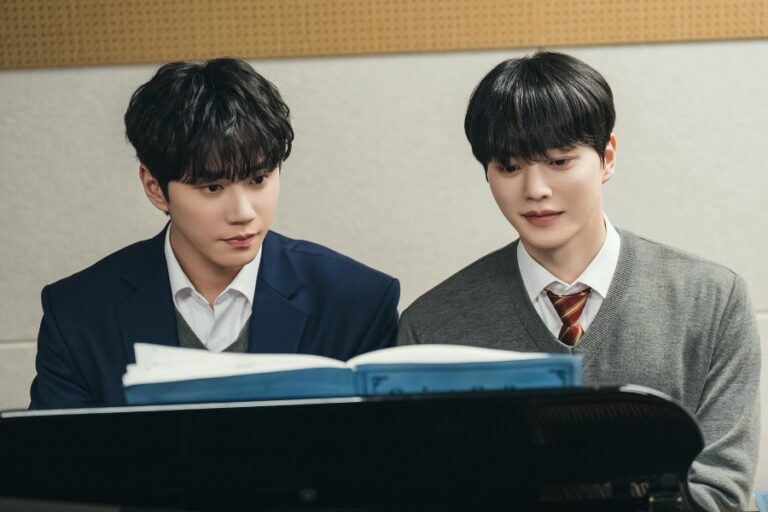
The second still shows both characters seated beside each other at a single piano, their attention directed toward shared sheet music. The coldness characterizing their earlier interaction has dissolved, replaced by something quieter and more genuine—a natural comfort in shared space. Their body language suggests they have moved beyond defensive posturing into authentic collaboration. By positioning them at one instrument together, the image embodies the “four hands” concept that provides the drama’s title. This visual symbolizes that emotional walls have fallen and genuine connection has taken root.
Third Image: Unified Partnership From Separate Stations
The final still depicts both characters at their own pianos, positioned to face each other with solemn expressions. Having progressed from wary rivals through genuine friendship into artistic partnership, they stand at the threshold of creating something together—a performance where they function as distinct individuals yet operate as a unified artistic entity. The seriousness in their expressions conveys the magnitude of this moment, the significance of what they prepare to accomplish as partners. The image suggests completion of an arc while simultaneously marking a beginning.
Production Context and Broadcast Information
“Four Hands, Two Sonatas” will premiere on August 29 at 9:10 p.m. KST on tvN. The network continues its pattern of investing in youth-centered dramas that merge competitive ambition with emotional nuance. Song Kang’s ability to portray intensity and internal conflict, combined with Lee Jun Young’s capacity to render complexity and vulnerability, positions them well to deliver the sophisticated performance work this narrative demands. The selection of classical music as the central dramatic element provides both visual spectacle and philosophical depth—piano performance becomes metaphor for the larger themes of hard work versus natural talent, individual achievement versus collaborative creation, and how rivalry can transform into something far more meaningful.
Frequently Asked Questions
When does 'Four Hands, Two Sonatas' premiere?
The drama premieres on August 29 at 9:10 p.m. KST on tvN.
What is the central conflict between the two main characters?
Kang Bi Oh (Song Kang) is a hard-working genius who practices 10 hours daily, while Choi Jung Yo (Lee Jun Young) is a transfer student with innate musical talent. Their rivalry stems from different pathways to achievement.
How does Choi Jung Yo's dream of becoming a pianist begin?
After accidentally hearing Kang Bi Oh's piano performance, Choi Jung Yo feels his passion for becoming a pianist reawaken, inspiring him to pursue his dream again.
