
Key takeaways
- Lee Jung Eun and Kong Hyo Jin lead a mother-daughter revenge mission in The Journey to Gyeongju, a film centered on a family seeking answers eight years after their youngest daughter disappeared.
- Promotional stills reveal escalating danger as the family progresses from driving a ramshackle van to fleeing through dark mountains while pursued by people carrying flashlights.
- The film explores family-centered revenge rather than individual vengeance, distributing narrative weight across a mother and three sisters bound by shared grief and collective purpose.
- The film releases in Korean theaters on August 26, positioning itself as a distinctive entry in Korean revenge cinema through its focus on feminine perspectives and generational trauma.
Newly unveiled promotional stills for “The Journey to Gyeongju” reveal a family bound by grief and purpose, masking sinister intentions beneath the veneer of an ordinary vacation. The upcoming Korean film follows a mother and three daughters as they journey toward Gyeongju eight years after the youngest daughter vanished during a school field trip and never returned. With Lee Jung Eun, Kong Hyo Jin, Park So Dam, and Lee Yeon carrying the narrative forward, the film crafts a meditation on how collective loss transforms into collective action, driven by patience worn into resolve.
The Facade of an Ordinary Trip
What appears on the surface to be a family excursion conceals a far darker mission. Ok Sil, the mother portrayed by Lee Jung Eun, travels alongside her three daughters—Jang Ju (Kong Hyo Jin), Young Ju (Park So Dam), and Dong Ju (Lee Yeon)—in pursuit of answers and reckoning. The eight-year gap between their youngest daughter Gyeong Ju’s disappearance and this journey becomes central to understanding the family’s psychological state. This extended period of waiting has crystallized grief into determination, transforming passive suffering into active purpose.
Visual Language of Deterioration
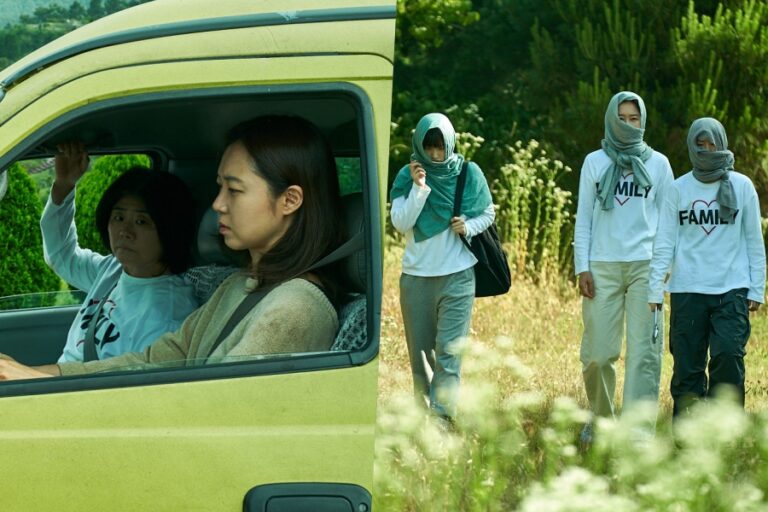
The promotional imagery establishes tone through careful attention to mundane detail. Ok Sil and Jang Ju are captured driving an aged yellow van patched haphazardly with duct tape along a mountainous route. The vehicle’s condition—battered, hastily repaired, held together by necessity rather than care—mirrors the family’s emotional architecture. Their expressions as they drive are notably grim, stripped of any lightness or joy. There is no anticipation here, no holiday excitement. Instead, the pair radiates determination tinged with dread, suggesting they are traveling toward confrontation rather than retreat.
The Ritual of Matching Shirts
One still captures the family standing in an uncomfortable lineup outside a warehouse structure, each member dressed in matching T-shirts bearing familial designations: “Mom,” “First Daughter,” “Second Daughter,” and “Third Daughter.” The uniformity speaks to coordination and collective identity, yet their body language betrays no warmth or solidarity. Instead, their stance suggests obligation—they are bound together not by choice but by shared tragedy and shared mission. The matching attire functions as both uniform and armor, a visual assertion of family unity while paradoxically emphasizing the awkwardness of performing that unity.
Concealment and the Escalation of Stakes
As the narrative intensifies through the stills, the family’s actions become increasingly covert. Jang Ju, Young Ju, and Dong Ju traverse through dense bushes with their faces wrapped tightly in scarves, deliberately obscuring their identities from view. This intentional concealment raises immediate questions about their status—are they hiding from authorities, from potential witnesses, or from something else entirely? The wrapped faces suggest they exist in a liminal space between ordinary travelers and fugitives, between grieving family members and something more calculated.
Flight and Pursuit
The most dramatic still captures the crescendo of tension: Jang Ju and Dong Ju sprint through mountainous terrain at night, both wearing blue raincoats and clutching bags as they flee from pursuers armed with flashlights. The darkness, the urgency of their run, the aggressive pursuit—these elements transform the narrative from a story about searching for answers into a story about evading consequences. Whatever actions the family has taken in Gyeongju, they have triggered responses serious enough to warrant a nighttime chase through wilderness. The imagery raises questions that promotional stills are designed to leave unanswered: What have they done? Who pursues them? What crosses have they stepped over in the name of revenge?
The Memorial Within the Vacation
Perhaps the most unsettling image depicts the family kneeling in unison before a traditional memorial table positioned within their accommodation space. A cake sits upon the table, a jarring collision of celebratory object with memorial ritual. This scene encapsulates the film’s central emotional complexity—the blending of ordinary family moments with remembrance, and possibly something darker still. The memorial setup transforms lodging space into shrine, a physical manifestation of how the missing daughter Gyeong Ju dominates every aspect of this journey. Even within moments that might otherwise be considered rest or sustenance, the family’s grief and purpose intrude.
Genre and Thematic Ambition
“The Journey to Gyeongju” positions itself within Korean revenge cinema, yet distinguishes itself through its focus on collective female action rather than solitary masculine vengeance. The film distributes its narrative weight across a mother and three daughters, examining how grief functions across generational lines and how shared trauma binds family members together through shared purpose. The absence of a father figure or male authority structure places the burden and agency entirely on these four women, a deliberate thematic choice that shapes how audiences understand their actions and motivations.
Family as Weapon
The film suggests that family itself becomes a weapon in their quest. The matching shirts, the coordinated movements, the shared concealment—these are not acts of individual revenge but collective ones. The mother-daughter dynamic introduces complexity that purely individual revenge narratives cannot achieve. Ok Sil must navigate both her role as matriarch and her position as a grieving parent, while her three daughters must reconcile their own separate losses with their mother’s needs and her mission.
Cast and Production Credibility
The ensemble brings considerable depth to roles that demand both restraint and intensity. Lee Jung Eun’s presence as Ok Sil carries the weight of maternal authority and maternal desperation—two contradictory forces that must coexist. Kong Hyo Jin, Park So Dam, and Lee Yeon navigate the terrain of sisterhood complicated by trauma, each actress bringing distinct energy to their role. The caliber of the cast suggests the production intends to explore character development and interpersonal nuance alongside thriller mechanics, avoiding the pitfall of reducing the family to mere plot devices.
Release and Cultural Context
“The Journey to Gyeongju” arrives in Korean theaters on August 26. The strategic timing of these promotional stills serves multiple functions: establishing narrative mystery, allowing speculation about the film’s trajectory, and creating anticipation within Korean cinema audiences. The visual language established through these images—the aged van, the matching uniforms, the wrapped faces, the nighttime pursuit—creates a coherent aesthetic that suggests intentional filmmaking rather than genre formula.
The choice of Gyeongju as destination carries cultural resonance in Korean cinema and literature, as the city represents history, heritage, and the weight of the past. The family’s literal journey toward this historical city mirrors their psychological journey toward reckoning with their own history—the eight-year absence that has defined their family structure and reshaped each member’s identity.
Frequently Asked Questions
What is The Journey to Gyeongju about?
The film follows a mother (Ok Sil) and three daughters (Jang Ju, Young Ju, and Dong Ju) who embark on a revenge journey eight years after their youngest daughter Gyeong Ju vanishes during a school field trip and never returns.
Who stars in The Journey to Gyeongju?
The film stars Lee Jung Eun as Ok Sil (the mother), Kong Hyo Jin as Jang Ju, Park So Dam as Young Ju, and Lee Yeon as Dong Ju.
When does The Journey to Gyeongju release in theaters?
The film is set to hit theaters in Korea on August 26.
