
Key takeaways
- The Assassin(s) follows a police detective, newspaper editor, and rookie journalist investigating the August 15 shooting that shocked South Korea.
- Each protagonist refuses to back down from the investigation despite facing pressure and threats from those seeking to bury the truth.
- The three leads converge on the central question: who gave the order for the assassination, not just who carried it out.
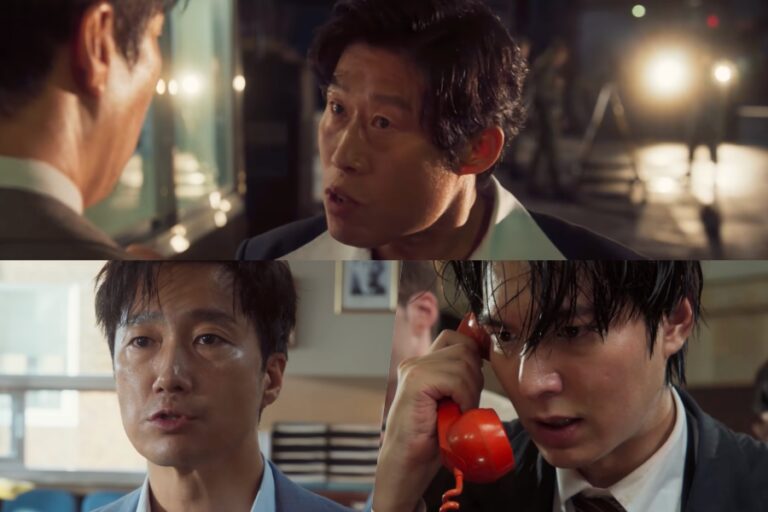
“The Assassin(s)” investigates the mystery and forces behind the August 15 shooting incident that shocked South Korea. A newly released teaser introduces three protagonists pursuing the truth behind the assassination attempt: a police detective, an established journalist, and a rookie reporter. Each comes to the case from a different institutional position, bringing distinct methods and motivations to uncovering what happened and who authorized it.
The Police Response: Superintendent Cheol Gu
Refusing to Look Away
Yoo Hae Jin portrays Cheol Gu, a police superintendent at Jungbu Police Station who witnesses the assassination attempt and becomes central to the investigation. Colleagues immediately caution him with a warning that could allow the case to be buried: “This isn’t something we should get involved in.” Rather than accepting this as reasonable advice about a dangerous matter, Cheol Gu rejects the premise entirely. “We’re doing this to catch the culprit,” he responds firmly. “Isn’t that our job?” His words frame the investigation not as a political minefield to navigate, but as fundamental police work that cannot be abandoned. The teaser establishes his core conviction: investigating crime is not a choice—it is the essential duty of law enforcement, regardless of what pressures surround the case.
The Journalistic Pursuit
An Editor’s Conviction: Jae Hwan
Park Hae Il plays Jae Hwan, an editor in the social affairs department at Dongsung Daily newspaper. Unlike Cheol Gu’s institutional authority, Jae Hwan operates from journalistic principle. He is actively tracking the circumstances surrounding the assassination, driven by a commitment to expose truth. When discussing the investigation with Cheol Gu, he articulates his foundational belief: “What’s important to a reporter is the truth.” He presses further with a pointed question: whether catching the culprit matters regardless of who they turn out to be—a question that implies answers might implicate powerful figures. That suspicion proves justified when Sang Pil, an intelligence agency agent portrayed by Park Hoon, directly threatens him. Even under this pressure, Jae Hwan refuses to retreat, invoking professional duty: “I have a duty to let the people know.” His stance is rooted in the principle that information should not be suppressed by institutions, no matter how powerful.
A Rookie’s Relentless Questions: Young Il
Lee Min Ho steps into the role of Young Il, a rookie reporter who approaches the case with entirely different energy. Rather than Jae Hwan’s principled journalism or Cheol Gu’s institutional authority, Young Il pursues answers through relentless questioning and physical action. The teaser captures him asking questions, racing around the scene, and following every available clue. A key observation defines his investigative instinct: “The person trying to hide something is the culprit. But everyone is hiding something right now.” This statement reveals both his sharpness and his recognition that the case is far more complicated than identifying a single perpetrator. In this drama’s world, information itself becomes a contested resource that multiple parties want to control or conceal.
Threats and Opposition
The teaser’s structure deliberately intercutting the three leads with glimpses of the assassin preparing the crime establishes a race narrative. But it also signals the obstacles ahead. The intelligence agency presence—represented by Sang Pil threatening Jae Hwan—suggests the assassination was not an isolated act but part of a larger scheme that powerful institutions want buried. The warnings to Cheol Gu to abandon the investigation reinforce this. The drama poses an implicit question: how far can these three go when institutional forces are aligned against them?
Three Paths Converging
In one particularly intense sequence shown in the teaser, Cheol Gu, Jae Hwan, and Young Il are depicted shouting together: “Tell me the truth. Who gave the order?” This question becomes the investigation’s central line. It moves beyond identifying the assassin—the person who pulled the trigger—to uncovering the authority structure that authorized the crime. A second utterance follows: “Let’s bring together our burning hearts,” revealing that despite coming from different positions, the three will collaborate.
What the Teaser Reveals About the Stakes
The teaser’s power lies in establishing both individual determination and collective purpose. Cheol Gu brings police authority and procedural legitimacy, Jae Hwan brings journalistic conviction and access to wider audiences, and Young Il brings relentless energy and a fresh perspective unburdened by institutional caution. Together, they suggest that the investigation is larger than any one person or institution can accomplish alone. The case is not just about solving a crime—it is about uncovering who holds power and how they use it.
Frequently Asked Questions
What is 'The Assassin(s)' about?
The drama investigates the mystery and forces behind the August 15 shooting incident that shocked South Korea, following a police detective, newspaper editor, and rookie reporter as they pursue the truth behind the assassination attempt.
Who are the three main characters?
Yoo Hae Jin plays police superintendent Cheol Gu, Park Hae Il plays newspaper editor Jae Hwan, and Lee Min Ho plays rookie reporter Young Il. Park Hoon portrays intelligence agency agent Sang Pil.
What obstacles do the investigators face?
The investigators face pressure from colleagues warning them to stay out and direct threats from intelligence agencies seeking to bury the truth. Despite these obstacles, all three refuse to abandon their pursuit of answers.
