
Key takeaways
- Park Hae Kang and masked apartment mothers launch a YouTube livestream exposing Lee Choong Won's corruption, escalating their conflict beyond private negotiation and into public accountability.
- Evidence discovered at the apartment complex's kindergarten facility becomes the foundation for their exposure, revealing that systematic corruption affects the community's most vulnerable residents.
- The livestream represents a contemporary narrative about collective resistance where ordinary residents leverage digital platforms and social media visibility to pressure institutional power structures.
JTBC’s “The Apartment Job” pivots toward public confrontation in its forthcoming episode, as the protagonist abandons private negotiation in favor of digital-age exposure. The drama follows Park Hae Kang, a former member of the Oasis Gang portrayed by Ji Sung, who has infiltrated the leadership structure of an apartment complex’s resident council. His goal is transactional: to access the complex’s hidden reserve fund, valued at 10 billion won, approximately $7.1 million. The central antagonist, Lee Choong Won, played by Park Byung Eun, controls access to these funds but demands increasingly unacceptable prices in exchange.
The Conflict Reaches a Breaking Point
Lee Choong Won’s Escalating Demands
In the drama’s most recent episode, Lee Choong Won presented Park Hae Kang with a stark ultimatum: commit murder in exchange for the 10 billion won. The demand crosses a moral boundary that Park Hae Kang refuses to cross, signaling that negotiation between the two men has reached its limit. This refusal effectively declares open conflict—a moment in which Park Hae Kang moves from attempting to work within Lee Choong Won’s corrupt system to actively challenging it.
The 10 Billion Won Necessity
Park Hae Kang’s desperation for the 10 billion won drives the entire narrative. Without it, his plans—whatever they may be beyond simple financial gain—cannot proceed. His background as an Oasis Gang member suggests he has enemies or obligations that require substantial capital to address. Lee Choong Won’s leverage over the reserve fund and his willingness to weaponize that control pushes the conflict beyond mere corruption into active coercion.
A Pivot to Public Exposure
YouTube as a Weapon
Having rejected Lee Choong Won’s murderous demand and recognizing that private negotiation has exhausted itself, Park Hae Kang adopts an unexpected counterstrategy: a livestream on YouTube. By taking the corruption public and broadcasting it in real time, he transforms the conflict from a private power struggle into a public scandal. This shift reflects a contemporary approach to institutional accountability—using digital platforms and social media virality as pressure mechanisms against entrenched actors who previously operated with impunity in the shadows.
The Visual Strategy of Collective Action
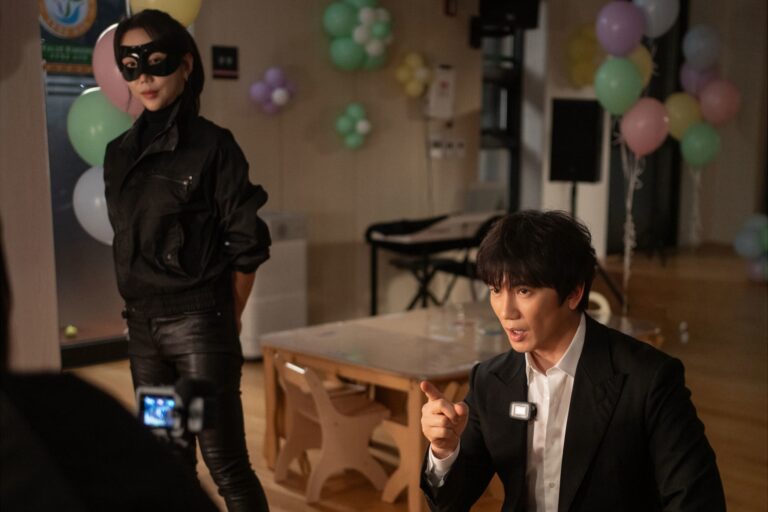
Production stills released ahead of the August 8 broadcast reveal the carefully constructed visual presentation of the livestream. A group of mothers from the apartment complex, including the character Cha Yoon Jo portrayed by Son Ji Yoon, participate in the broadcast alongside Park Hae Kang. Each mother wears an identical cat mask during the livestream, a detail that simultaneously obscures individual identity while creating a unified visual statement. The entire group is dressed in matching black outfits, further emphasizing their collective stance against Lee Choong Won and his corruption.
Transforming Residents into Activists
The inclusion of apartment complex mothers in the livestream is significant. These are not professional activists or journalists but ordinary residents whose lives have been affected by the systemic corruption they aim to expose. By featuring them alongside Park Hae Kang, the drama suggests that the fight against Lee Choong Won is not a personal vendetta but a collective resistance movement. The mothers represent the broader community of residents who have a stake in exposing and ending the corrupt practices.
Evidence and the Kindergarten Discovery
The masked mothers and Park Hae Kang do not broadcast without substantiation. They bring evidence gathered from within the apartment complex, specifically material discovered at the complex’s kindergarten facility. The fact that evidence of corruption extends to a space designated for children adds a layer of moral urgency to their public exposure. The kindergarten discovery suggests that Lee Choong Won’s malfeasance touches even the most vulnerable residents—the children of the complex.
According to the production team’s official statement: “Park Hae Kang and the moms of the apartment complex will join forces to launch a powerful counterattack against Lee Choong Won. A small clue found at the kindergarten becomes the trigger for uncovering massive corruption. Please stay tuned to find out what the results of their collaborative effort will be.” This framing positions the kindergarten discovery as a catalyst for broader institutional exposure, suggesting that what begins as a small detail expands into systemic revelation.
The Broadcast and Its Implications
The livestream on YouTube represents a critical narrative moment in “The Apartment Job.” It shifts the drama from a story of individual infiltration and negotiation into one of collective resistance and public accountability. By broadcasting, Park Hae Kang and the mothers risk direct retaliation from Lee Choong Won and his network, but they gain the protection and amplification that public visibility provides. In a digital era, the threat of public exposure and viral spread can pressure authorities and institutions in ways that private complaints cannot.
Broadcast Schedule and Network Details
The episode featuring the YouTube livestream is scheduled to air on JTBC on August 8 at 10:40 p.m. KST. This timing continues the drama’s regular broadcast schedule and places the public exposure moment at a crucial juncture in the narrative arc. JTBC’s willingness to center this episode around digital activism and social media-driven exposure reflects contemporary storytelling interests in how institutional power is challenged in the modern era.
Cast Context and Production Perspective
Ji Sung’s portrayal of Park Hae Kang requires the actor to navigate a complex character arc: from organized crime subordinate to apartment council candidate to public activist. Park Byung Eun’s Lee Choong Won embodies institutional corruption and the willingness to use violence and coercion to maintain power. Son Ji Yoon’s Cha Yoon Jo, one of the apartment mothers leading the livestream, represents the point of intersection between ordinary residents and the larger conflict. Together, this ensemble creates a narrative about corruption at the granular level of apartment complex governance, where the stakes are simultaneously personal and systemic.
“The Apartment Job” continues to develop its premise that institutional power can be challenged when ordinary people decide to act collectively and leverage the tools available in the digital age. The YouTube livestream represents a turning point where the drama’s central conflict becomes public, irrevocable, and subject to external scrutiny rather than contained within the apartment complex’s walls.
Frequently Asked Questions
How much money is Park Hae Kang trying to access from the apartment complex?
Park Hae Kang is attempting to access 10 billion won—approximately $7.1 million—from the apartment complex's hidden reserve fund.
Why do the mothers wear cat masks during the YouTube livestream?
The identical cat masks obscure individual identity while creating a unified visual statement. Combined with matching black outfits, they emphasize the mothers' collective stance against Lee Choong Won and his corruption.
When does the livestream episode air?
The episode featuring the YouTube livestream is scheduled to air on JTBC on August 8 at 10:40 p.m. KST.
